
Chief Scientist – Methodology Stewardship and Scientific Governance
Search Sciences™ is governed, not promoted.
At Younis Group, responsibility for the design, evolution, and integrity of the Search Sciences™ methodology sits with the Chief Scientist.
This role exists to ensure that the methodology remains evidence-led, technically rigorous, and aligned with how modern discovery systems actually function.
Scientific Accountability
The Chief Scientist is responsible for the scientific accountability of Search Sciences™.
This includes:
Conceptual Integrity
Ensuring that terms such as entity, authority, attribution, and representation are defined consistently and used precisely across all work.
Ambiguity is treated as risk.
Evidence Standards
Ensuring that decisions are based on observed system behaviour rather than assumptions, trends, or industry folklore.
Where evidence is incomplete, uncertainty is documented rather than ignored.
Measurement Frameworks
Designing and maintaining measurement systems that reflect interpretation and representation rather than surface-level performance metrics.
This includes model-level observation, attribution analysis, and representation stability over time.
Ethical Application
Ensuring that Information Science principles are applied responsibly, particularly in environments where misinformation, bias, or misrepresentation create real-world harm.
Separation from Commercial Incentives
This separation exists to ensure that methodological decisions are not influenced by commercial pressure to oversimplify, overpromise, or generalise.
Scientific integrity takes precedence over convenience.
This distinction is critical in high trust environments where accuracy matters more than scale.
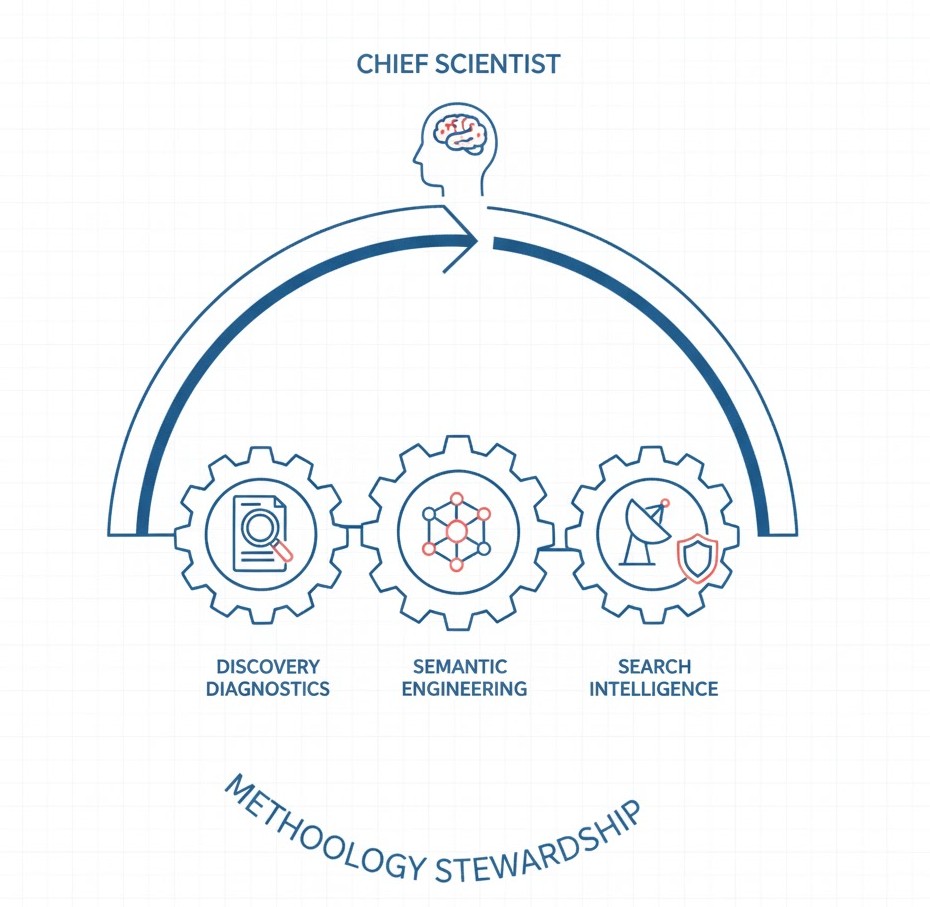
Oversight Across the Search Sciences™ Phases
Discovery Diagnostics
Ensuring that observation remains forensic rather than confirmatory.
Semantic Engineering
Ensuring that implementation reflects diagnostic evidence rather than preconceived solutions.
Search Intelligence
Ensuring that governance focuses on representation integrity rather than superficial performance indicators.
This oversight ensures continuity of intent from diagnosis through long-term governance.
Interpretation as a Scientific Responsibility
Meaning is inferred, synthesised, and summarised by machines.
The Chief Scientist is responsible for studying how this interpretation occurs and for designing systems that reduce ambiguity, distortion, and unintended consequence.
This is not optimisation.
It is interpretive risk management.
This responsibility is operationalised through Search Intelligence Governance.
Public Methodology Responsibility
As a social enterprise, Younis Group applies the same Information Science principles to public good initiatives addressing data poverty, digital exclusion, and information inequality.
Methodology stewardship includes ensuring that these principles are transferable, ethical, and beneficial beyond commercial use.
Why This Role Exists
Most methodologies degrade over time.
They become simplified. Productised. Detached from the systems they were designed to address.
The Chief Scientist role exists to prevent this outcome.
It ensures that Search Sciences™ remains an applied Information Science methodology rather than a marketing construct.
Stewardship Before Scale
Search Sciences™ is intentionally governed before it is scaled.
This ensures that growth does not come at the expense of accuracy, trust, or scientific discipline.
The Chief Scientist exists to protect that balance.