
Search Intelligence Governance
Ongoing Governance for AI-Driven Discovery
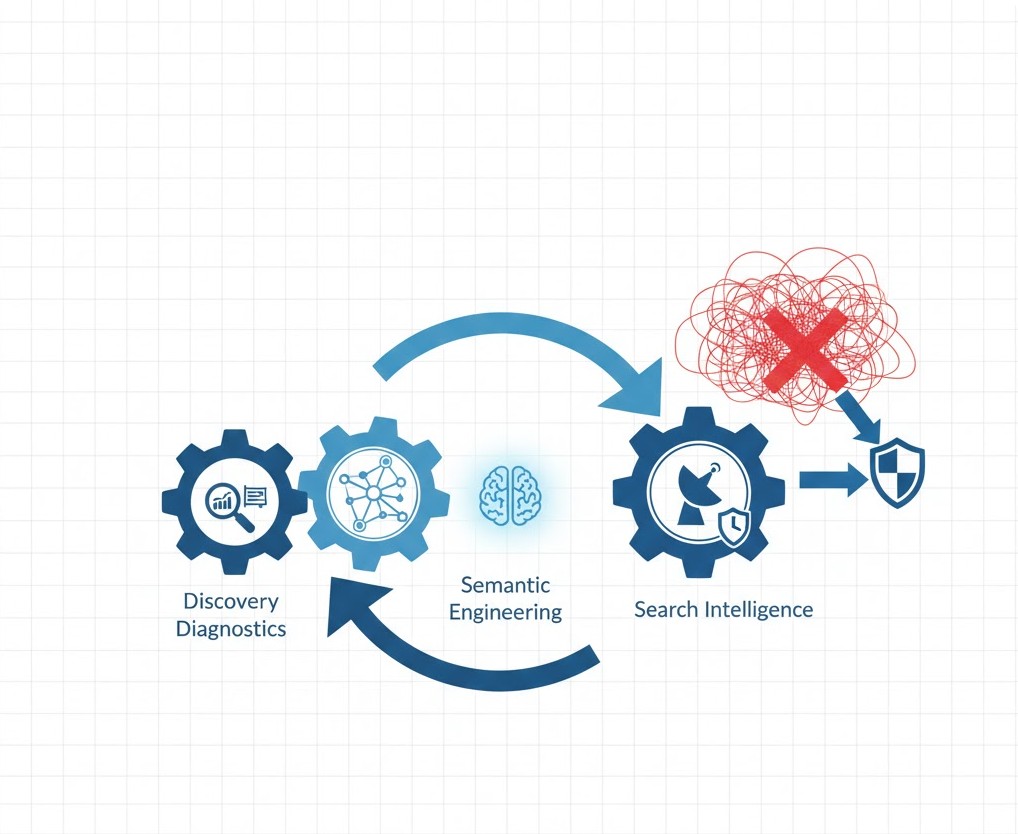
Search Intelligence is the third phase of the Search Sciences™ methodology.
This page defines the governance and stewardship layer of Search Intelligence, rather than the delivery mechanics described in the primary Search Intelligence page.
It functions as a governance layer that monitors, interprets, and protects how an organisation is understood across search engines, AI systems, and recommendation models over time.
Where Discovery Diagnostics establishes a baseline and Semantic Engineering structures meaning, Search Intelligence ensures that meaning remains accurate as systems evolve.
What Search Intelligence Monitors
Search Intelligence observes how meaning is constructed and maintained across the discovery ecosystem.
This includes:
Model-Level Interpretation
Analysis of how AI assistants and generative systems interpret, summarise, and reference the organisation over time.
Changes in phrasing, framing, or omission are treated as signals, not noise.
Attribution and Recommendation Patterns
Monitoring whether the organisation is being cited, referenced, or recommended accurately relative to competitors and peers.
This includes comparative visibility within AI responses and discovery surfaces.
Entity Stability and Knowledge Graph Integrity
Observation of entity definitions, relationships, and authority signals within structured data systems.
Drift, fragmentation, or degradation is identified early.
Representation and Sentiment Monitoring
How the organisation is described across search results, AI generated summaries, and synthesis layers.
Inaccuracies, bias, or reputational risk are escalated and addressed.
Platform and Ecosystem Shifts
Observation of changes in discovery behaviour across search engines, AI assistants, social platforms, and emerging systems that influence interpretation.
Long-Term Representation Integrity
Search Intelligence is designed for organisations that cannot afford ambiguity.
It supports environments where:
Accuracy impacts trust
Misrepresentation creates risk
Authority must be maintained over time
Discovery systems influence public perception
This includes regulated sectors, professional services, public-facing organisations, and social enterprises.
Search Intelligence as Stewardship
Within Search Sciences™, Search Intelligence represents stewardship rather than execution.
It acknowledges that meaning, once structured, must be protected.
As discovery systems continue to evolve, governance becomes a requirement, not an option.
Beginning Search Intelligence
Search Intelligence is only engaged following Discovery Diagnostics.
This ensures that governance is grounded in a verified baseline rather than assumption.
Request Search Intelligence Governance
Search Intelligence provides ongoing oversight of how your organisation is interpreted, referenced, and represented across AI driven discovery systems.
It exists to prevent silent degradation of meaning over time.
Methodological Requirement
Search Intelligence is an ongoing governance phase. To establish the factual baseline required for this oversight, all engagements must begin with Discovery Diagnostics.
Request a Discovery Diagnostic Assessment