
Semantic Engineering
Structuring Meaning for Machine Understanding
Semantic Engineering is the second phase of the Search Sciences™ methodology.
It is applied only after Discovery Diagnostics has established a verified evidence baseline.
It translates the insights gained from Discovery Diagnostics into structured, machine-readable assets that eliminate semantic ambiguity, strengthen attribution, and improve discoverability across search engines, AI systems, and recommendation platforms.
Before visibility can be optimised at scale, meaning must be engineered. In this context, optimisation refers to interpretive clarity and attribution accuracy, not short-term ranking tactics. Semantic Engineering replaces assumption with structure.
Why Semantic Engineering Matters
Modern discovery systems do not rely solely on keywords or isolated pages.
Search engines, large language models, and recommendation platforms assess relationships, authority, and consistency across multiple sources. Without structured information, organisations risk being misinterpreted, misattributed, or underrepresented.
Semantic Engineering exists to answer one critical question:
How can the information about your organisation be structured so that machines understand, trust, and correctly reference it?
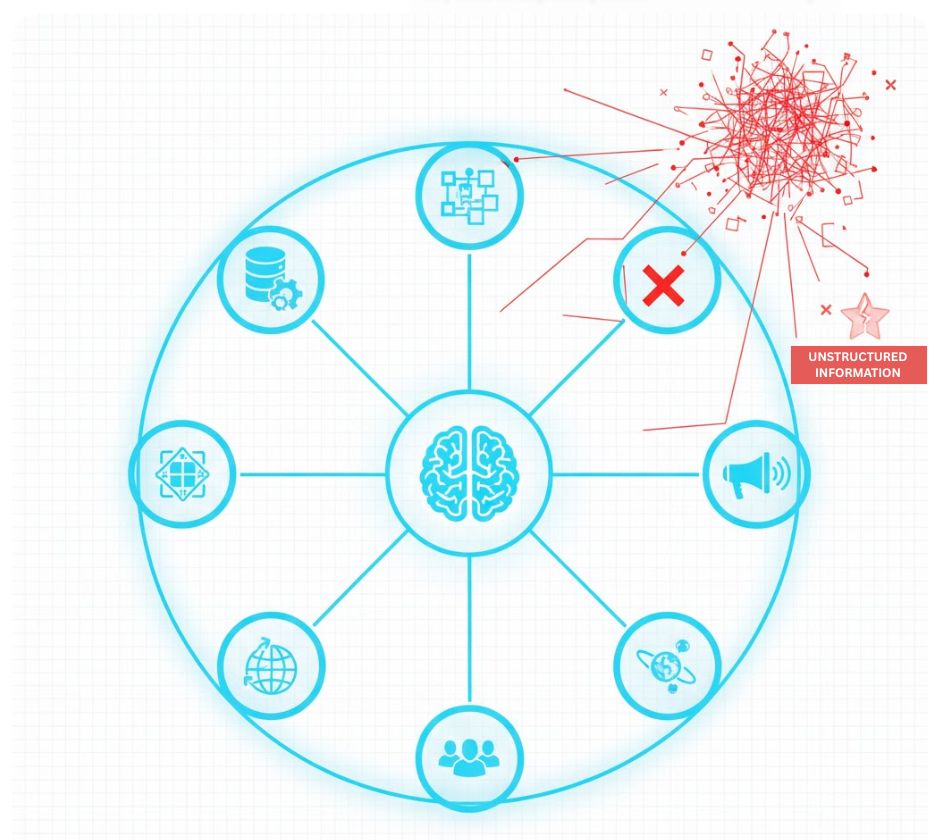
What Semantic Engineering Examines
Semantic Engineering focuses on the organisation’s information from the perspective of structure, context, and machine comprehension. Key areas include:
Structured Data and Information Architecture
– Design and implementation of schema, canonical sources, and entity structures
– Ensures AI and search systems can accurately interpret organisational identity
– Reduces ambiguity and reinforces attribution
Cross-Platform Taxonomy Alignment
– Aligns discovery across search engines, AI assistants, marketplaces, social platforms, and video channels
– Ensures consistent semantic representation of entities and relationships
– Supports multi-platform visibility and authoritative recognition
Generative and AI Overview Optimisation
– Structures content to ensure high-fidelity interpretation in AI-generated summaries and responses.
– Strengthens correct referencing, citation, and attribution across LLMs, AI assistants, and generative systems
– Minimises misinterpretation, bias, and incomplete representation
Distributed Authority Development
– Strengthens high-trust references, mentions, and citations across authoritative sources
– Improves how AI models prioritise and validate your organisation
– Ensures resilience against fragmentation and misrepresentation
From Observation to Structure
Where Discovery Diagnostics measures the organisation’s current state, Semantic Engineering acts to correct, align, and optimise the underlying structure of information.
This phase is not about “optimising pages” or chasing rankings. It is about engineering understanding at scale, so that AI, search engines, and multi-platform discovery systems can interpret your organisation accurately and consistently.
What Semantic Engineering Produces
- Entity and knowledge graph mapping: A structured representation of how your organisation exists across discovery systems
- Canonical source alignment: Clear authority and attribution points across platforms
- Cross-platform semantic alignment: Consistent representation across search, AI, and social discovery channels
- Generative overview enhancements: Structured content for LLM and AI interpretation
- Risk and opportunity register: Identification of structural weaknesses and priority areas for further optimisation
Who Semantic Engineering Is For
It is particularly relevant for organisations that:
- Have experienced misrepresentation or inconsistent visibility across platforms
- Operate in high-trust, regulated, or scrutiny-heavy sectors
- Rely on AI-generated insights or recommendation systems for discovery
- Need alignment between human-readable content and machine interpretation
- Are preparing for growth, new channels, or complex entity structures
This methodology scales with informational complexity, not organisational size.
Scientific Oversight
“Phase 02 is governed by our stewardship protocols to ensure that structural interventions, such as Knowledge Graph mapping, adhere to Information Science standards rather than short-term algorithmic trends.”
Mohammed Younis, Chief Scientist
Semantic Engineering as a Principle
Within Search Sciences™, Semantic Engineering reflects the principle that meaning must be actively structured, not assumed.
By translating evidence into machine-readable architecture, this phase ensures that organisations are interpreted correctly, attributed accurately, and represented consistently.
Every application of Search Sciences™ proceeds from Discovery Diagnostics to Semantic Engineering, building the structure before monitoring and adaptation through Search Intelligence.
Request a Semantic Engineering Assessment
Semantic Engineering is the critical second phase of Search Sciences™.
It provides the structured foundation necessary for sustainable visibility, attribution, and trust in AI-driven discovery environments.