
Manufacturing & Industrial Discovery
Eliminating Metadata Loss to Enable Clarity, Procurement Precision and Customer Confidence
Manufacturers and industrial organisations produce some of the most technically detailed, specification-rich products and systems in the global economy. These goods range from bespoke components for specialised machinery to complex assemblies with precise tolerances, materials requirements and regulatory compliance metadata. For engineers, procurement professionals and buyers in B2B supply chains, discovering the right supplier with the right specification at the right time is a high-stakes challenge.
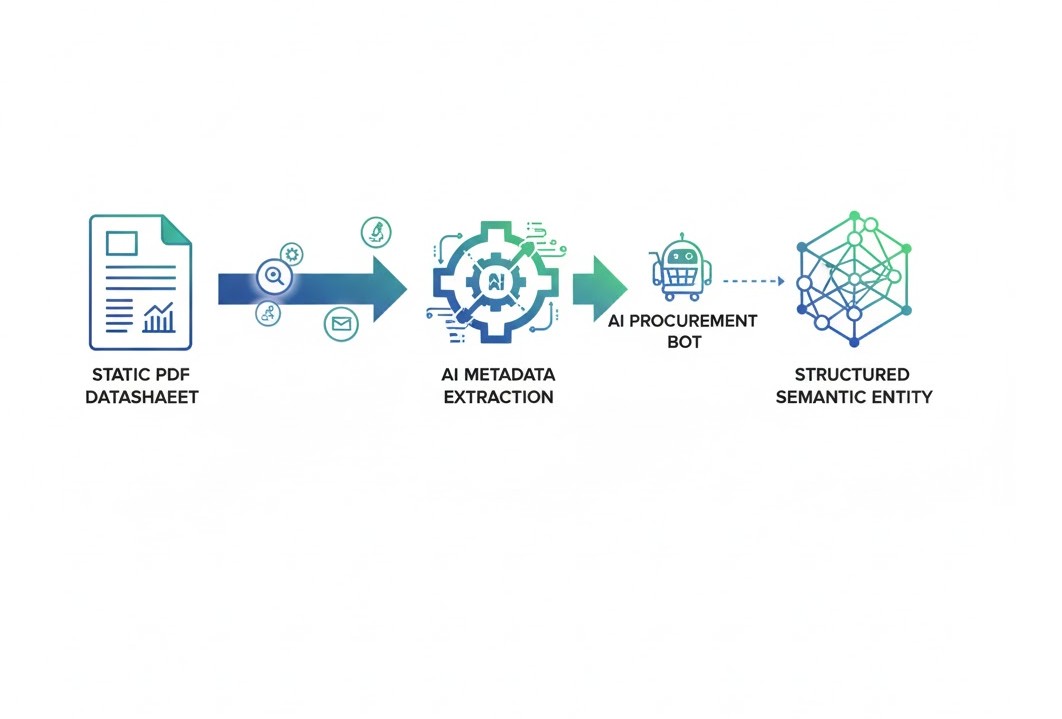
Yet most discovery systems — search engines, AI assistants, marketplace engines and procurement platforms — struggle to interpret the structured details that matter most in manufacturing. Complex metadata is often missing, inconsistent or buried in unstructured formats such as PDFs or product datasheets, meaning that discovery systems cannot accurately interpret, relate or recommend products based on the nuanced parameters that define them.
This page explains how our Search Sciences™ methodology addresses the unique risk of metadata loss in industrial contexts and helps manufacturers be found and understood across modern digital discovery environments.
The Manufacturing Information Challenge
Manufacturing search behaviour is inherently different from consumer search behaviour. Industrial buyers use long-tail queries that are specification driven. They search with intent and precision, seeking exact materials, dimensions, industry standards, performance tolerances or certification compliance in their queries.
For example:
- “ISO-certified linear actuator 400mm stroke automation cell”
- “food-grade PTFE hose 10mm diameter high temperature 260C”
- “pressure regulator for nitrogen lines 150 psi”
These searches contain rich semantic signals that traditional, unstructured product information cannot satisfy. When metadata is incomplete, inconsistent or unstandardised, discovery systems fail to match these queries with the correct product entities. As a result, manufacturers lose visibility to the very buyers actively seeking their solutions.
Industrial product information challenges include:
- attributes buried in unstructured text or PDFs rather than in machine-readable fields
- inconsistent naming conventions across similar components
- scattered specifications that lack normalised attribute taxonomies
- missing interoperability context for compatible components
- lack of structured data in compliance or certification metadata
Without addressing these issues, manufacturers remain effectively invisible to AI tools and search systems that could otherwise connect them directly to procurement demand.
Metadata Loss and Digital Discovery
Metadata is the foundation of machine understanding. It provides context, relationships and interpretive clarity for products, systems, certifications and compatibility. When metadata is incomplete, ambiguous or poorly governed, discovery systems cannot interpret products as coherent, structured entities.
AI models and next-generation discovery systems increasingly demand high-quality metadata to interpret semantic relationships and surface accurate results. When metadata is absent or misleading, AI models return incomplete, vague or incorrect outputs, leaving buyers uncertain, misinformed or defaulting to commoditised alternatives.
The limitations of AI systems in handling vague or unstructured data are well documented. AI models frequently struggle with metadata that is unclear or inconsistent, leading to misinterpretations, inaccuracies in output and a reduced ability to leverage complex datasets effectively.
For manufacturers, this limitation affects not just discovery but real-world procurement outcomes. Buyers consulting AI assistants, generative tools or supplier databases may be unable to shortlist the correct supplier, find compatible equipment or verify compliance information if product metadata is not clearly and consistently represented.
Industrial Procurement in an AI-Driven World
Procurement managers, supply chain teams and engineers now start their research with generative AI and conversational tools. These systems can shortlist vendors, compare specifications and assess product suitability before a human reviewer sees any results. If metadata is weak, a manufacturer’s products do not appear in responses, shortlists or supplier comparisons — even when they match the buyer’s requirements perfectly.
AI tools are being asked for information such as:
- vendors with ISO 9001 or other compliance certifications
- materials that meet specific industry standards
- comparative performance between similar technical components
- suppliers with available stock or lead times
If a product’s technical attributes, certification status or stock availability are not expressed in machine-readable, standardised metadata, AI cannot recommend the product. In this context, metadata loss equates to lost contracts, missed orders and reduced pipeline opportunities.
Beyond Procurement: Customer Experience and Real-Time Relevance
Good data does not only make your organisation easier to find. It makes your products easier to use, compare and choose. When metadata is structured and up to date:
- buyers can check stock levels, lead times and compatibility before submitting enquiries
- engineers can find products that meet exact tolerances, materials and certification requirements
- supply chain teams can trust automated systems for forecasting and replenishment planning
- AI assistants can answer natural language queries with accurate, context-rich details
Structured metadata transforms discovery from a guessing game into a reliable, predictable result, making interactions between manufacturers and buyers more efficient and transparent.
How Search Sciences™ Reduces Metadata Loss
Search Sciences™ applies evidence-led methods to ensure manufacturing data is interpretable, consistent and discoverable across search and AI systems.
Scientific Oversight: “In the industrial sector, an unindexed specification is a non-existent specification. We treat metadata as a critical piece of infrastructure—as essential as the machinery itself. Without structural integrity in your data, your products remain ‘invisible’ to the automated procurement systems that now dominate B2B supply chains.”
Mohammed Younis, Chief Scientist
Entity Definition and Specification Modelling
We formalise each product, component and material as a machine-readable entity with clear attribute definitions, standardised formats and measurable properties. This allows systems to distinguish fine-grained technical differences confidently.
Structured Product Taxonomy Alignment
We align product attributes with recognised classification standards and meaningful keywords so that discovery systems understand compatibility, function and performance rather than vague descriptions.
Cross-Platform Attribution Mapping
We analyse product representation across multiple platforms — search engines, procurement portals, AI assistants and marketplaces — to identify gaps and inconsistencies that lead to misinterpretation or omission.
Semantic Integrity and Metadata Governance
We apply governance frameworks to ensure metadata remains consistent over time, enabling models to interpret attributes reliably as products evolve and systems update.
Manufacturing is a data-rich, specification-intensive environment. When discovery systems cannot interpret complex metadata, both suppliers and buyers face friction. Buyers struggle to find the right products quickly, engineers repeat searches with different terms, procurement cycles lengthen, and suppliers lose competitive opportunities.
By strengthening metadata quality, making data machine-readable and aligning attribute representations, Search Sciences™ helps manufacturers:
- improve their visibility across procurement and AI-driven discovery systems
- reduce missed opportunities from specification mismatch or metadata ambiguity
- provide richer, more accurate information to buyers and AI models
- shorten procurement cycles and increase conversion for high-intent queries
Good metadata is not an optional enhancement. It is the core of discoverability in an AI era where buyers expect context-rich, accurate responses and where machine understanding drives decision-making.
If your manufacturing or industrial organisation seeks to improve how products are interpreted, connected and surfaced across discovery systems, start with a Discovery Diagnostic Assessment. This provides a factual baseline for how your metadata currently performs and highlights opportunities to enhance semantic clarity, attribute integrity and visibility for AI-driven procurement and discovery.