
Local & London Organisations Discovery
Enabling Civic, Community and Service Visibility Through Structural Information Science
Local organisations are the connective tissue of communities. They include small businesses, public services, charities, civic initiatives, educational support groups and essential infrastructure providers. These organisations serve real human needs — from health and education to food security, community welfare, transport accessibility and environmental action. Yet their ability to be discovered, understood and engaged with by citizens remains inconsistent and often poor.
Search and discovery systems increasingly synthesise information from across the web. They assess context, consistency, relationships and authority before deciding what to surface or summarise. Where local data is incomplete, inconsistent or fragmented, discovery systems struggle to provide accurate, relevant results. This affects not just commerce but civic life, public service access, community support and quality of place. Our work applies Search Sciences™ to improve how local and London organisations are interpreted, connected and surfaced across modern discovery ecosystems.
The Local Information Landscape and Its Challenges
Local authorities and community organisations produce and hold vast quantities of data about people, places and services. However, data quality issues are widespread. Recent surveys of local authorities across England, Wales and Scotland reveal that poor data quality is a challenge for three quarters of organisations, affecting the consistency, completeness and reliability of records about services and communities. Common barriers include fragmented systems, legacy technology, lack of staff capacity, inconsistent data standards and insufficient investment in data quality and governance.
Local government data also suffers from lack of interoperability and inconsistent formats across departments and partner organisations. This does not just affect administrative reporting. It directly impacts how internal and public information is published, shared and reused. When discovery systems encounter such fragmented data, they cannot construct clear, reliable entity representations for critical civic services.
In London, despite significant investments in civic data infrastructure, many public bodies still struggle to reconcile and share data from different systems and departments. This makes it harder for residents, businesses and civic actors to find trustworthy information about local services, community support, planning, transport, environment and governance.
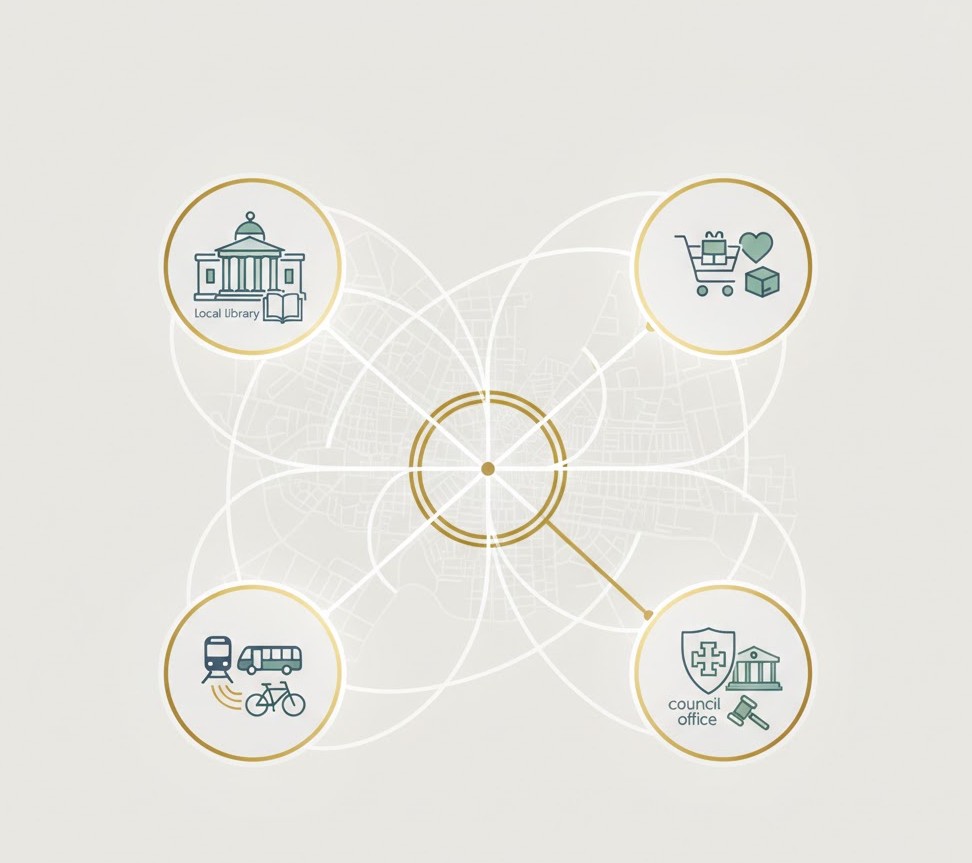
Why Hyperlocal Discovery Matters
Local and London organisations are the first point of contact for citizens seeking services and support. Whether a resident needs advice on housing, help with a food poverty initiative, access to adult education programmes, information about zero-emission zones, or details of local civic meetings, the quality of discovery matters.
Inaccurate or missing data leaves residents unsure where to go, undermines trust in public institutions and creates invisible barriers to vital services. For example, charities like Citizens Advice, which support millions across the UK with legal, debt and housing advice, rely on accessible, discoverable information to connect people with assistance.
Similarly, organisations such as mySociety build tools that help citizens engage with government transparency, report local issues and understand public processes. Yet their impact is limited when local authoritative data is inconsistent or inaccessible.
Hyperlocal discovery is not just about business listings. It is about ensuring civic services, community support groups, education resources, public health programmes and environmental initiatives are discoverable at the right time, in the right context, and in a way that reflects how people actually search for help and support in their daily lives.
The Cost of Data Poverty in Civic Services
When local information is not reliably structured and discoverable, a range of societal harms can follow:
Barriers to Essential Support: People facing food insecurity, housing instability, health challenges or educational disadvantages may find it difficult to locate accurate information about available support services.
Reduced Civic Participation: Inaccessible information about council meetings, community events, participatory budgeting and local consultation processes limits democratic engagement.
Strained Public Services: Public services that cannot easily be discovered or understood may face higher demand for basic enquiries, duplication of effort and frustration among users.
Fragmented Community Networks: Local community initiatives and grassroots organisations may be overlooked, weakening social cohesion, support networks and community resilience.
These outcomes reflect not just gaps in data but in how discovery systems interpret local contextual information when it is unstructured, inconsistent or poorly integrated across platforms.
London as a Data Innovation and Civic Discovery Benchmark
London is a uniquely complex and vibrant metropolitan area with one of the most diverse ecosystems of civic services, community organisations and public programmes in the world. It hosts multi-layered governance structures, numerous boroughs, powerful civic tech communities, and major cultural, educational and health institutions.
Platforms such as the Data for London Library demonstrate a commitment to improving access to datasets about the city’s services, population and infrastructure. This initiative brings thousands of datasets into a shared, discoverable library, supporting researchers, policymakers and communities with evidence for decision-making.
London is also home to funded civic data innovation challenges that aim to strengthen the understanding and accessibility of community data across borough boundaries and sectors.
This combination of data ambition and civic complexity makes London an ideal environment to refine, test and showcase how structured, high-quality local data can be made discoverable across modern systems. A London benchmark for search sciences and local data governance would not only improve civic discovery for residents, businesses and visitors but also create a model for other cities globally.
How Search Sciences™ Addresses Local Discovery Challenges
Local and London organisations require structured, interpretable, trustworthy information to be found and used effectively in discovery systems. Search Sciences™ improves this by:
Scientific Oversight: “A city is more than just geography; it is a complex web of services. When discovery systems fail to accurately ‘see’ a local charity or a public clinic, that service effectively disappears for the citizen in need. We apply Search Sciences™ to ensure that the digital map of London is as accurate and accessible as the physical one.”
Mohammed Younis, Chief Scientist
Entity Definition and Semantic Coherence
We identify and structure local entities such as councils, charities, civic programmes, community hubs, support services and educational resources into machine-readable forms that capture their relationships and context.
Standardised Local Profiles
By creating consistent profiles for local organisations across platforms, including structured address data, services descriptions, contact details, accessibility information and governance details, we help discovery systems match intent to the right entity.
Cross-Platform Attribution and Connectivity
We map how local data appears across search engines, AI assistants, databases, directories, maps services and civic platforms to identify gaps and inconsistencies in representation.
Generative and Conversational Readiness
We structure data to improve the likelihood that AI assistants and generative systems provide accurate, relevant information about local services, rather than confusing or generic summaries.
In an era where people increasingly turn to search engines, AI assistants, and digital platforms for civic information, the quality of local data affects everyday life. From finding a community food programme to understanding changes in public transport, from identifying charitable support to engaging with local planning consultations, local organisations must be discoverable and their information must be reliable.
By applying structured semantic approaches to local and London data, we support:
- Greater civic engagement
- Better access to public services and community support
- Enhanced local economic participation
- An equitable digital experience for all residents
Strong local discovery is not an optional extra. It is a foundation for healthy, equitable and resilient communities.
If you represent a local organisation, civic service, community initiative or public programme seeking to improve how your services are interpreted, connected and surfaced across search and AI systems, we recommend beginning with a Discovery Diagnostic Assessment. This establishes how your information footprint currently exists and highlights opportunities to strengthen interpretation, relevance and accessibility in modern discovery ecosystems.