
B2B Technology & SaaS Discovery
Resolving Semantic Ambiguity in Complex Software and Enterprise Solutions
Business-to-business (B2B) technology and software-as-a-service (SaaS) firms operate in one of the most complex discovery environments today. Unlike consumer products where attributes may be obvious and discrete, enterprise software solutions are multifaceted, configurable and highly specialised. Modern discovery systems, including search engines and AI assistants, now synthesise information based on semantic relationships, entity coherence and context rather than simply matching keywords.
For technology and SaaS providers, the principal information risk is semantic ambiguity. This occurs when AI models cannot reliably interpret or distinguish complex features, integrations, use cases and differentiators inherent to software platforms. When ambiguity exists, generative systems will either provide incomplete summaries, cite competitors incorrectly, or exclude your solution entirely from recommendations.
This page explains how Search Sciences™ helps B2B technology and SaaS organisations clarify their information footprint so that discovery systems can interpret, connect and surface their offerings accurately to enterprise buyers.
The Modern B2B Discovery Context
The traditional B2B purchasing journey was long and linear, with buyers using search engines and structured evaluation criteria before engaging with vendors. Today that process has fundamentally changed. A growing number of enterprise buyers are turning directly to AI assistants and generative tools during the early stages of vendor research. These systems summarise capabilities, compare features and provide shortlist recommendations before users ever navigate to a vendor’s site.
If a SaaS vendor’s information is poorly structured, inconsistent or semantically opaque, AI systems may misinterpret or omit it entirely from discovery outputs. This creates a visibility crisis for firms whose solutions are genuinely competitive but whose machine-readable signals are weak or fragmented compared to competitors.
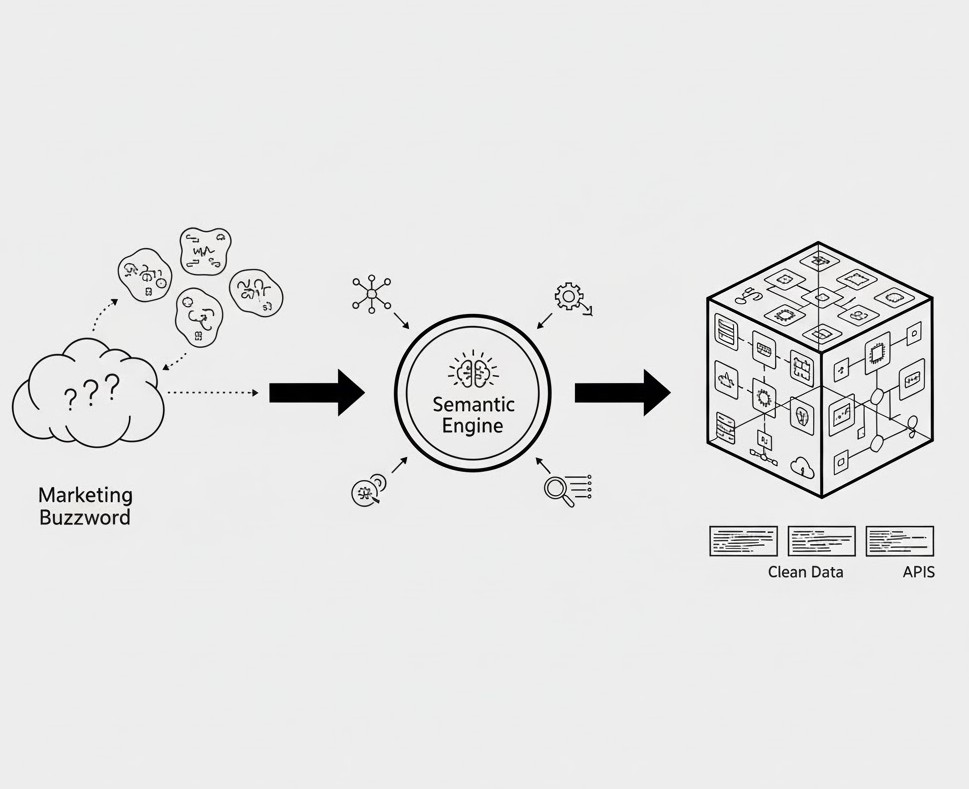
What Semantic Ambiguity Looks Like
Semantic ambiguity in B2B technology and SaaS arises when feature sets, use cases, deployment models, integrations, pricing tiers and enterprise-grade differentiators are not clearly linked in a machine interpretable way. Examples include:
- Descriptions that rely on marketing jargon rather than structured terminology
- Feature matrices that are inconsistent across pages or platforms
- Complex integrations mentioned in free text without formal entity links
- Absence of structured data to indicate supported protocols, APIs or standards
- Product comparisons that lack clear relational context
When AI models encounter inconsistent or fragmented profiles, they struggle to map queries about intent, capability and differentiation to the correct vendor. In practice this can result in a vendor being referenced generically or overlooked entirely in generative answers and recommendations.
The Enterprise Buyer Behaviour Shift
A growing proportion of B2B buyers now begin their technology research with conversational queries addressed to AI assistants. Industry studies increasingly indicate that a significant proportion of enterprise technology buyers rely on chatbots and generative systems as their primary resource for vendor discovery, often more than traditional search engines.
This shift reflects a broader move away from ten blue link results towards zero-click discovery, where AI answers and comparisons are synthesised in response panels or chat interfaces without the user ever visiting a vendor’s website. Vendors that are not clearly represented in those systems miss critical opportunities to influence early-stage consideration and shortlisting.
Why SaaS and Technology Products Are Especially Vulnerable
SaaS and enterprise technology products often have extended feature sets, modular pricing and bespoke deployment options that require nuanced understanding by both buyers and machines. Analysts and industry researchers note that B2B SaaS companies frequently struggle with AI visibility because models cannot reliably differentiate nuanced features or present comparison results that meaningfully reflect product strengths.
In contrast to simpler discovery contexts such as product retail, the purchasing decision for enterprise software involves multiple stakeholders, deeper evaluation cycles and higher trust thresholds. AI systems that misinterpret or oversimplify these complexities can distort how products are presented in discovery outputs.
How Search Sciences™ Reduces Semantic Ambiguity
Search Sciences™ applies a structured, evidence-led methodology to ensure technology and SaaS vendors are legible and interpretable by discovery systems.
Scientific Oversight: “In B2B SaaS, the greatest threat to growth is not the competitor; it is the ‘Semantic Fog’ created by unmapped feature sets. If an AI assistant cannot differentiate your API capabilities from a competitor’s, your competitive advantage effectively evaporates at the point of discovery.”
Mohammed Younis, Chief Scientist
Entity Definition and Semantic Precision
We define products, modules, feature categories and integrations as discrete, machine-readable entities with clear relational context. This helps models interpret queries about intent and match them to the right solution.
Semantic Integrity and Consistency
We align product information with standard industry taxonomies and structured data formats so that discovery systems can distinguish between superficially similar terms and understand nuanced differentiation.
Cross-Platform Attribution Mapping
We analyse how product entities, documentation, APIs, whitepapers and case studies are referenced across search engines, AI assistants and marketplace ecosystems to identify and close gaps in representation.
Feature and Use Case Contextualisation
We ensure that feature descriptions, use cases, deployment options and integration frameworks are semantically connected so that AI systems can produce accurate, context-rich summaries for enterprise buyer queries.
In the modern B2B technology landscape, digital discovery is increasingly governed by generative systems that prioritise semantic clarity and entity coherence over conventional ranking metrics. Vendors that are semantically ambiguous risk:
- Being omitted from AI-generated comparative responses
- Having their features misrepresented in generative summaries
- Losing prime consideration in early-stage buyer research
- Falling behind competitors whose machine readable signals are more coherent
By applying semantic engineering and entity modelling, Search Sciences™ helps technology and SaaS organisations maintain durable visibility, accurate representation and meaningful engagement with enterprise buyers.
If your technology or SaaS business seeks to strengthen how it is interpreted, connected and surfaced across modern discovery systems, we recommend beginning with a Discovery Diagnostic Assessment. This establishes how your current information footprint exists and identifies opportunities to enhance semantic clarity, context, and relevance for AI and enterprise discovery.