
Search Sciences™ – An Applied Information Science Methodology for Modern Discovery
Search Sciences™ is Younis Group’s applied Information Science methodology.
It is a structured, evidence-led system designed to improve how organisations are interpreted, connected, and represented across the global discovery infrastructure over time.
Rather than optimising isolated pages or channels, Search Sciences™ focuses on how information about an organisation is structured, validated, and synthesised across the global discovery ecosystem.
This methodology is platform-agnostic, scalable, and designed for long-term resilience in environments shaped by artificial intelligence.
Methodology Ownership and Application
Search Sciences™ is developed, maintained, and applied by Younis Group as an organisational methodology. It is governed through defined scientific oversight and applied consistently across all client engagements.
This ensures that Search Sciences™ functions as a stable, repeatable system rather than a collection of individual tactics or practitioner-specific approaches.
Why Search Sciences™ Exists
Modern discovery systems no longer rely on keywords alone.
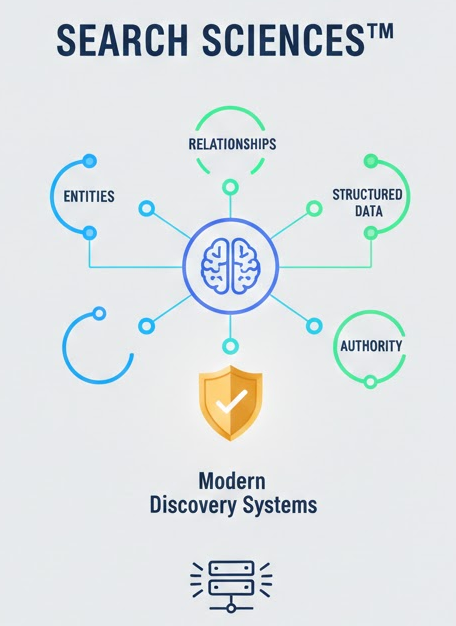
Search engines, large language models, and recommendation platforms operate on entities, relationships, and structured information. They evaluate consistency, authority, and context across many sources before deciding what to surface, reference, or recommend.
Traditional SEO methods are insufficient in this environment.
Search Sciences™ was developed to address this shift by applying core principles from Information Science to real-world discovery challenges.
From Keywords to Knowledge
Traditional SEO organises text.
Information Science organises meaning.
Search Sciences™ applies concepts from:
- Information retrieval
- Ontology and taxonomy design
- Knowledge graph theory
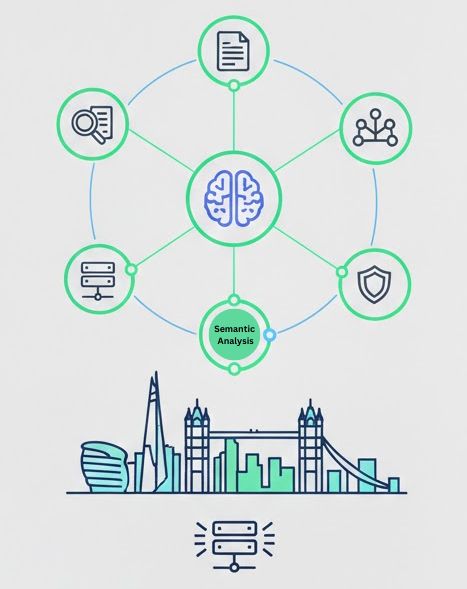
- Semantic analysis
- Information systems and model behaviour
to ensure an organisation is understood as a coherent, authoritative entity rather than a collection of disconnected pages.
This is how organisations become referenced, trusted, and accurately represented across search engines and AI-driven systems.
What Search Sciences™ Optimises
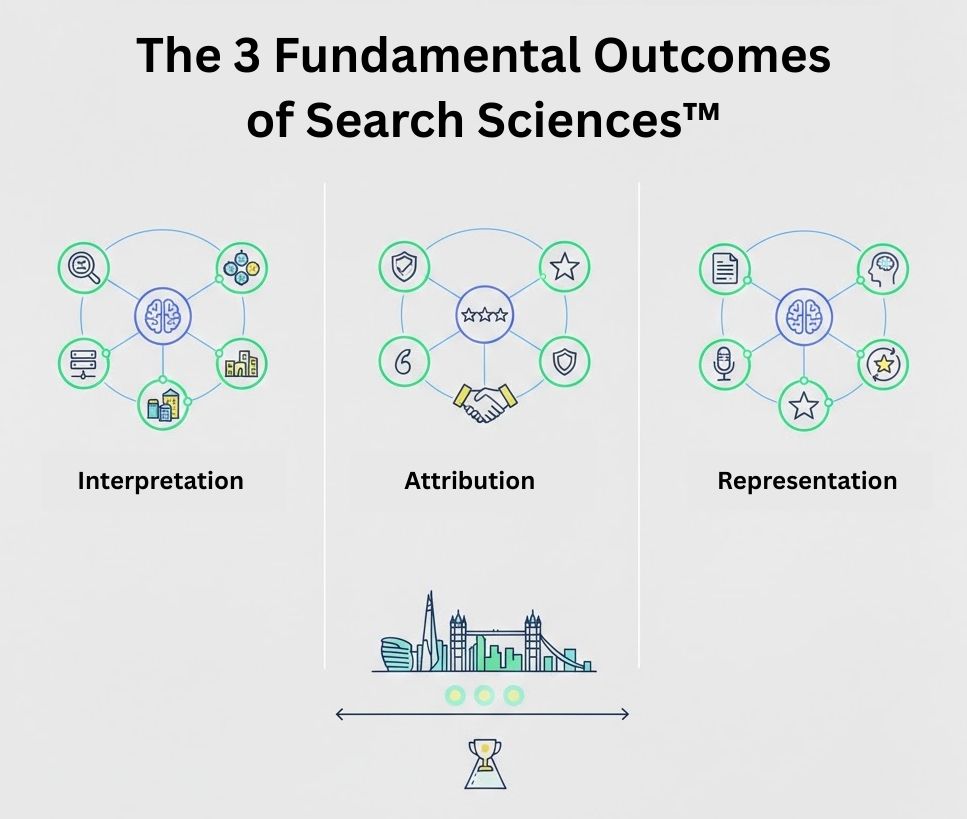
Search Sciences™ focuses on three fundamental outcomes:
Interpretation – How machines understand what an organisation is, what it does, and how it relates to other entities.
Attribution – How credit, authority, and references are assigned across search results and AI-generated outputs.
Representation – How an organisation is described, summarised, and recommended across discovery systems over time.
These outcomes matter regardless of organisation size. They affect visibility, reputation, and trust at every level.
What Search Sciences™ Is Not
Search Sciences™ is not a traditional SEO campaign, a content production system, or a channel-specific optimisation framework.
It does not focus on short-term ranking tactics or platform-specific loopholes. Instead, it provides a disciplined system for structuring, validating, and governing organisational information across evolving discovery environments.
The Three-Phase System
Search Sciences™ is delivered through a three-phase methodology. Each phase builds on the previous one and serves a distinct purpose.
Phase 01: Discovery Diagnostics – Mapping the Information Footprint
Discovery Diagnostics establishes a factual baseline.
This phase measures how an organisation currently exists across search engines, data providers, social platforms, and AI systems. It identifies fragmentation, inconsistency, and structural weaknesses that limit visibility and attribution.
Key areas of analysis include:
- Technical integrity and machine accessibility
- Entity representation and knowledge graph relationships
- Information entropy across the web
- Gaps in the wider discovery ecosystem
This phase replaces assumptions with evidence and informs all subsequent decisions.
Phase 02: Semantic Engineering – Structuring Meaning for Machine Understanding
Semantic Engineering is the implementation phase.
Insights from Discovery Diagnostics are translated into structured, machine-readable assets that reduce ambiguity and improve attribution across discovery systems.
This phase focuses on:
- Structured data and information architecture
- Entity definition and canonical sources
- Cross-platform taxonomy alignment
- Generative and AI overview optimisation
- Distributed authority development
The objective is not to optimise pages, but to engineer unambiguous understanding at scale.
Phase 03: Search Intelligence – Ongoing Interpretation, Protection, and Adaptation
Search Intelligence is the continuous strategy layer.
As algorithms evolve and AI systems change how information is synthesised, this phase ensures an organisation remains accurately represented and competitively visible across the discovery infrastructure.
Key functions include:
- Discovery Share Analysis across platforms
- Share of Model analysis across AI assistants
- Model interpretability and algorithm response
- Search sentiment and representation monitoring
- Early detection of visibility or attribution drift
This phase prevents silent degradation in AI-driven discovery environments and supports long-term resilience.
Search Sciences™ is designed for organisations operating in environments where accuracy, trust, and visibility matter, including:
– Small and growing organisations requiring foundational entity authority
– Regulated and high-trust sectors
– Public sector and social impact organisations
– Technology platforms and data-driven businesses
The methodology scales based on complexity, not organisation size.
Search Sciences™ is not tied to a single platform, channel, or algorithm.
It is evidence-led, meaning decisions are based on observed data rather than assumptions or best-practice templates.
It is platform-agnostic, meaning it adapts as discovery systems change rather than optimising for one channel at the expense of others.
This approach supports durable visibility in an AI-driven landscape.
As a social enterprise, Younis Group reinvests 60% of profits into initiatives that address data poverty, digital exclusion, and information inequality in London.
The same Information Science principles applied to client work are used to support community-focused digital infrastructure and services.
Search Sciences™ is not only a commercial methodology. It is also a framework for improving how information is structured, accessed, and trusted.
Start with Discovery
Every application of Search Sciences™ begins with a Discovery Diagnostic assessment.
This ensures clarity, accountability, and alignment before any implementation work begins.
Methodological Stewardship
Search Sciences™ is a living methodology governed through formal scientific oversight. The Chief Scientist provides methodological stewardship to ensure that as AI models and discovery systems evolve, the framework adapts based on scientific evidence rather than industry trends.