
Professional Services Discovery
Resolving Authority Fragmentation in High-Trust Environments
The professional services sector includes finance, legal, accounting, consultancy and advisory firms whose value is defined by expertise, judgement and credibility. These firms operate in markets where clients make high-stakes decisions based on perceived authority and trust. In the evolving landscape of search engines, AI assistants and generative models, the way professional services firms are represented and interpreted matters more than ever.
Research shows that a large proportion of professional service providers struggle to build or maintain digital authority, even when their credentials and expertise are strong. Many firms report that potential clients search online for legal advice, financial guidance or professional consultancy, yet their online presence does not reflect their real-world expertise effectively. This gap between reputational strength and discovery visibility is increasingly impacting client acquisition, retention and competitive positioning.
Authority fragmentation occurs when an expert or firm with genuine credibility is poorly represented across digital platforms, leading to inconsistent or incomplete interpretations by discovery systems. In an age where search engines and AI summarise content, this fragmentation can result in generic AI responses that fail to cite or recommend the true authority on a subject.
This page explains the structural discovery challenges faced by professional services firms and how the Search Sciences™ methodology addresses them.
Understanding the Professional Services Discovery Landscape
Professional services operate in a complex information ecosystem that includes search engines, knowledge graphs, online directories, AI assistants, social platforms, review sites and regulatory or accreditation bodies. Modern discovery systems increasingly rely on entity recognition and relationship modelling rather than simple keyword matching to determine what to surface or recommend.
For firms whose expertise is embodied in both the person and the institution, a significant challenge arises when these two are not clearly connected to each other in structured information environments. This disconnect often means that AI assistants reference generic external sources instead of recognising the firm’s own experts, thought leadership content or service pages as authoritative.
Finance Sector: Trust, Compliance and AI Discovery
In financial services, firm reputation and expert credibility are critical because clients entrust advisors with their economic well-being. Clients increasingly start their research with search engines and AI assistants. If discovery systems cannot reliably distinguish between a certified financial planner, a chartered accountant or a generic financial blog, then firms risk losing visibility to less appropriate sources.
Regulatory compliance, structured data consistency and demonstrable expertise all contribute to how financial services firms are interpreted by discovery systems. AI-ready, compliance-aware content frameworks help ensure that models improve visibility for accurate, on-brand expert interpretation rather than surface irrelevant or non-authoritative information.
Legal Sector: Expertise, Authority and Digital Interpretation
Legal services have long been recognised as a high-trust domain, where error or misrepresentation can have serious consequences for clients. Prospective clients use natural language queries — often framed as problems or scenarios — to seek legal information and advice. AI-generated summaries often appear above traditional search results for these queries, but they may not reference the firm’s own expertise unless that firm’s entity signals are clear and consistent.
Research and market analysis show that most UK law firms have yet to adopt technical or semantic approaches that help them be selected by AI systems as trusted sources. Without structured authority, firms risk declining visibility and reduced referral opportunities from search and AI channels.
Authority fragmentation in legal contexts can manifest as AI assistants citing third-party articles or generic encyclopaedia entries instead of the firm’s own practice insights, case explanations or thought leadership. This diminishes brand recall and undermines trust in digital channels.
Advisory & Consultancy: Expertise Visibility Across Decision Journeys
Consultants, business advisors, and strategic commentators often hold deep domain knowledge but struggle to connect that insight to discovery workflows. Clients evaluating advisory services frequently perform research across multiple stages: initial understanding, comparison, evaluation and final selection. Without strong, machine-readable connections between expert insight and organisational identity, discovery systems are less likely to attribute authority to the consultancy itself.
Professional services firms that fail to articulate their expertise in formats that align with AI interpretation and entity recognition risk having their knowledge summarised by external sources that lack the firm’s contextual nuance.
What Authority Fragmentation Looks Like
Authority fragmentation shows up in several ways:
- AI assistants provide general answers that do not reference your firm or experts
- Search knowledge panels display incomplete or inconsistent firm information
- Expert profiles are scattered, with their contributions not linked back to your organisation
- Service pages are isolated from thought leadership and contextual resources
- External citations by AI systems lack your firm’s proprietary insights
When these signals are fragmented, discovery systems prioritise other sources, lowering your visibility in research and recommendation contexts.
How Search Sciences™ Restores Authority
Search Sciences™ applies evidence-led, structural methodologies to ensure your expertise and firm identity are clearly understood and attributed in modern discovery environments.
Scientific Oversight: “Trust is not a sentiment; in modern discovery, trust is a measurable network of verified entity relationships. If a discovery system cannot programmatically verify that an expert belongs to a firm, that firm’s authority effectively does not exist in the AI era.”
Mohammed Younis, Chief Scientist
Entity Definition and Relationship Mapping
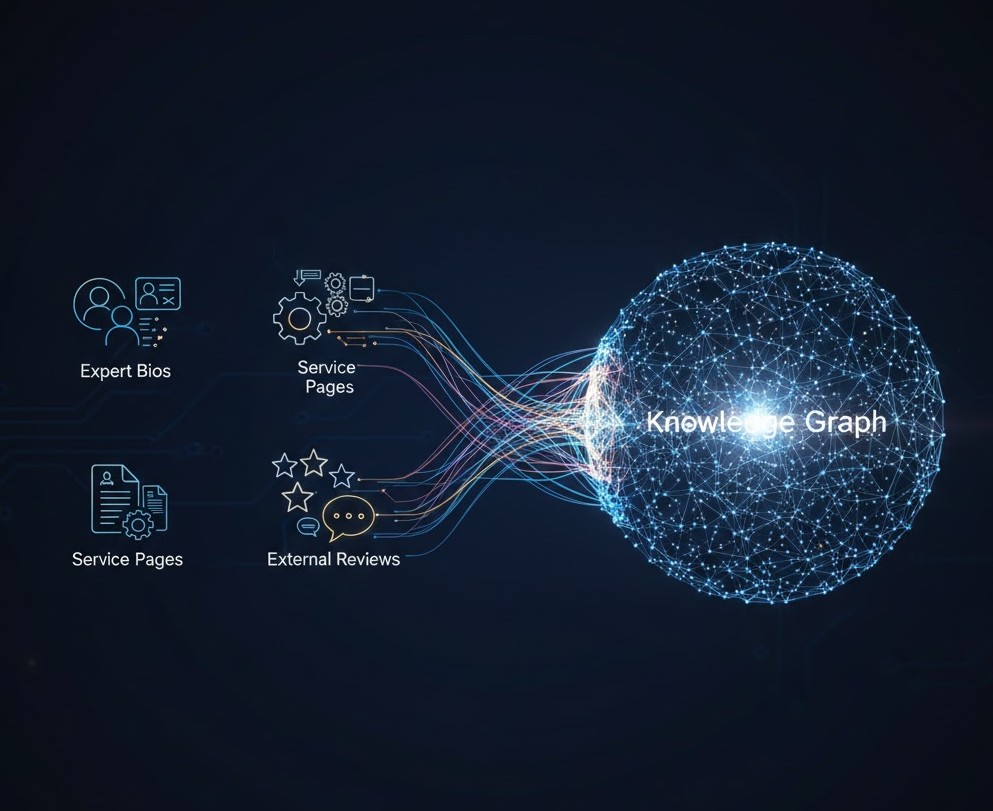
We identify and formalise the relationships between experts, their credentials, regulatory memberships, published insights and the organisational entity so that discovery systems recognise them as a coherent authority.
Semantic Integrity Across Platforms
We align semantic signals across service pages, expert profiles, insight content, regulatory listings and knowledge graphs so that AI systems interpret your organisation consistently.
Cross-Platform Citation and Attribution Mapping
We analyse how your organisation and experts are referenced across search engines, AI assistants, directories and industry platforms to identify fragmentation. We then close gaps so that authority signals reinforce rather than contradict each other.
AI and Generative Interpretation Preparedness
We optimise content structure so that AI assistants and generative models can produce accurate, context-rich summaries citing your firm and experts directly rather than defaulting to generic third-party sources.
Professional services are defined by trust, judgement and reputation. As more clients start their decision journeys with digital discovery and AI tools, how firms are interpreted, attributed and recommended matters for revenue and credibility.
Resolving authority fragmentation ensures that your firm and its experts are recognised as trusted sources of insight and advice. This strengthens visibility, deepens client confidence and supports long-term professional growth in a landscape where meaning matters more than keyword rankings.
If your professional services firm seeks to strengthen how it is interpreted, acknowledged and recommended across search engines and AI discovery systems, start with a Discovery Diagnostic Assessment. This establishes a factual baseline and identifies opportunities to improve entity clarity, semantic coherence and authority signals.