
Engagement Model
How Search Sciences™ Is Applied in Practice
Search Sciences™ is a structured Information Science methodology, not a collection of interchangeable services.
For this reason, engagement follows a defined sequence that prioritises evidence, clarity, and accountability over speed or assumption.
This page outlines how organisations engage with Younis Group, how decisions are made, and how responsibility is governed across the lifecycle of the methodology.
This engagement model operationalises the principles outlined in the Methodology hub and applies them consistently across all client work.
Principle One: Observation Precedes Intervention
All engagement begins with Discovery Diagnostics.
This is a methodological requirement to ensure that any subsequent action is predicated on observable data rather than conjecture.
Before meaning can be structured or representation improved, the existing information landscape must be observed as it currently exists. Without this baseline, any intervention risks amplifying inconsistency rather than resolving it.
Discovery Diagnostics establishes:
How the organisation is currently interpreted
Where misattribution or fragmentation exists
Whether structural intervention is required
What level of complexity is present
Only once this evidence is established can responsible decisions be made.
The Three Engagement Phases
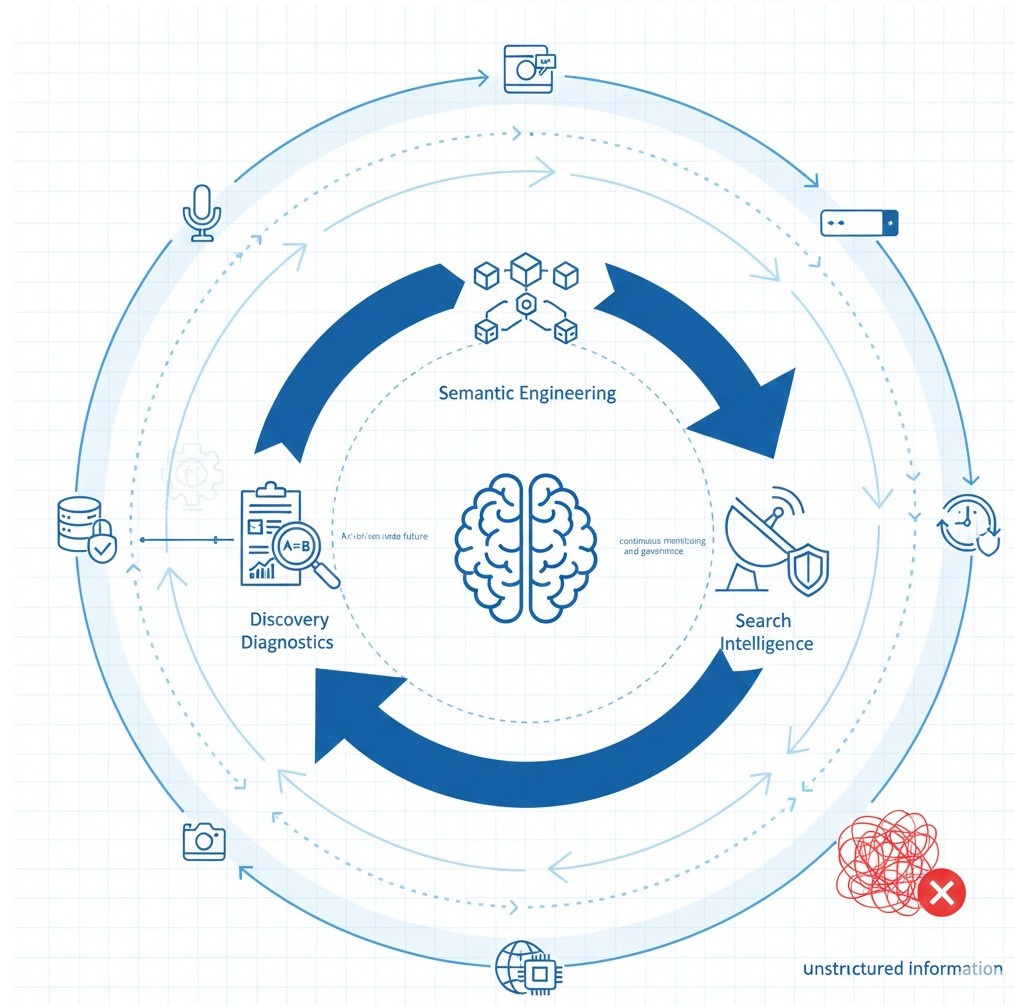
Engagement is structured around the three phases of Search Sciences™. Each phase has a distinct purpose, scope, and outcome.
Progression between phases is evidence-led, not assumed.
No phase is entered without the evidentiary conditions of the previous phase being met.
Phase One: Discovery Diagnostics
Fixed Diagnostic Engagement
Discovery Diagnostics is a defined, time-bound engagement focused on observation and measurement.
It produces a shared factual understanding of how the organisation exists across search engines, AI systems, and the wider discovery ecosystem.
This phase answers one question only:
How is the organisation currently understood?
No optimisation or restructuring occurs at this stage.
For full scope and outputs, see Discovery Diagnostics.
Phase Two: Semantic Engineering
Structured Implementation Engagement
Semantic Engineering is only initiated where Discovery Diagnostics identifies material semantic risk or structural ambiguity that warrants intervention.
This phase focuses on correcting ambiguity, fragmentation, and weak entity definition through machine-readable architecture and semantic alignment.
Scope is defined by diagnostic evidence, not templates.
Semantic Engineering may be delivered as:
A discrete implementation
A phased structural programme
A targeted intervention within specific systems
Not all organisations progress to this phase.
Phase Three: Search Intelligence
Ongoing Governance and Oversight
Search Intelligence is a continuous engagement designed to protect accuracy, authority, and representation over time.
As discovery systems evolve, meaning can drift. Attribution can decay. Representation can change without warning.
Search Intelligence exists to monitor, interpret, and respond to these changes before they result in silent visibility loss.
This phase functions as governance, not optimisation.
Governance standards for this phase are defined in Search Intelligence Governance.
Fixed Work and Continuous Work
Search Sciences™ distinguishes clearly between:
Diagnostic work
Implementation work
Ongoing oversight
Discovery Diagnostics and most Semantic Engineering engagements are fixed in scope.
Search Intelligence is continuous by design, reflecting the ongoing evolution of AI models, algorithms, and synthesis mechanisms.
This separation ensures clarity, accountability, and appropriate expectations at every stage.
Decision Gates and Integrity
Progression between phases is not automatic.
Each phase concludes with an evidence review that determines:
Whether further work is required
Which risks are material
What level of intervention is justified
In some cases, Discovery Diagnostics confirms that no immediate action is necessary.
This outcome is considered successful.
The methodology prioritises accuracy over activity.
These decision gates are enforced under the oversight of the Chief Scientist.
Governance and Accountability
All engagements are governed by measurable interpretation outcomes rather than surface-level performance metrics.
This includes monitoring:
Entity consistency
Attribution accuracy
Representation stability
Model-level interpretation trends
The objective is not short-term visibility gains, but long-term informational integrity across the discovery ecosystem.
Engagement at Appropriate Scale
Search Sciences™ scales with informational complexity, not organisational size.
Engagements are structured to reflect:
Number of entities involved
Platform exposure
Regulatory or trust sensitivity
Risk of misinterpretation
This ensures proportionality and methodological rigour regardless of organisation type.
Beginning an Engagement
Every application of Search Sciences™ begins with Discovery Diagnostics.
This establishes a shared factual baseline, defines risk, and determines whether further intervention is required.
No work proceeds without this clarity.
Request a Discovery Diagnostic Assessment
Discovery Diagnostics is the required entry point into the Search Sciences™ methodology.
It ensures alignment, accountability, and evidence-led decision making before any implementation begins.
Scientific Oversight “Our engagement model is designed to prevent the ‘activity for activity’s sake’ trap common in digital marketing. By installing formal decision gates, we ensure that every hour of engineering is justified by diagnostic evidence.”
Mohammed Younis, Chief Scientist