
Discovery Diagnostics
Establishing the factual baseline for modern discovery
Discovery Diagnostics is the first phase of the Search Sciences™ methodology.
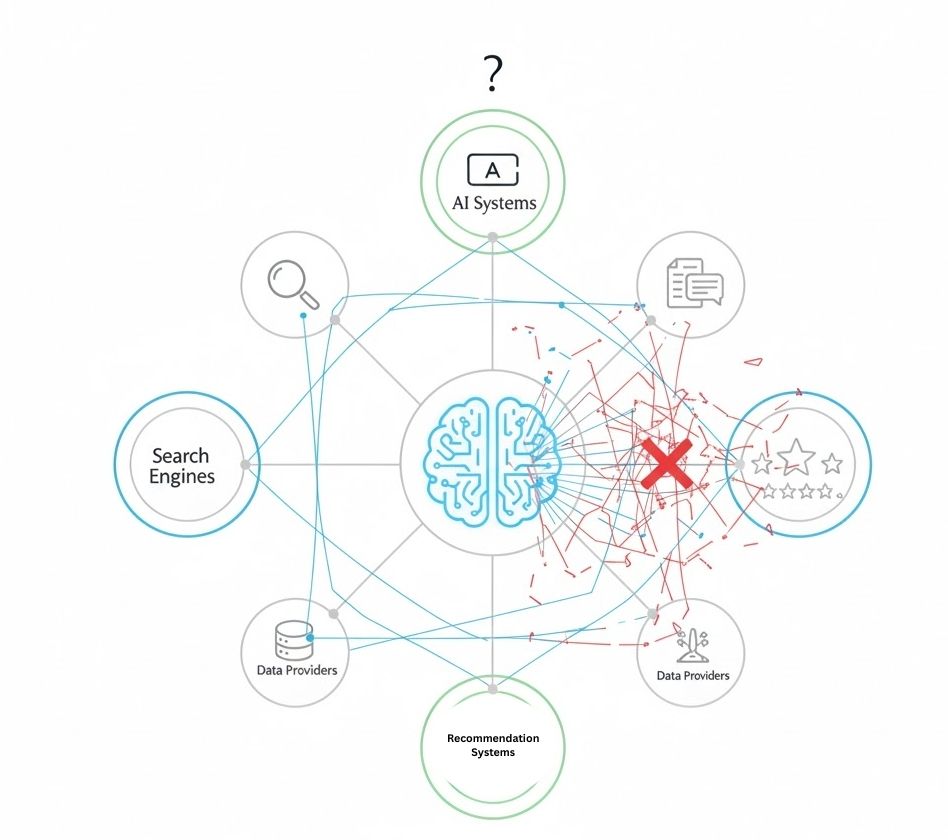
It establishes a clear, evidence-led understanding of how an organisation currently exists across search engines, AI systems, data providers, and recommendation platforms.
Before meaning can be structured or visibility improved, the information landscape must be measured as it is, not as it is assumed to be.
Discovery Diagnostics replaces assumptions with observable facts.
Discovery Diagnostics functions as the mandatory entry point into the Search Sciences™ methodology and governs how all subsequent semantic and interpretive work is prioritised.
Why Discovery Diagnostics Matters
Modern discovery systems no longer evaluate websites in isolation.
Search engines, large language models, and recommendation systems synthesise information from across the web. They assess consistency, authority, and relational context before deciding what to attribute, summarise, or reference.
Without a verified baseline, optimisation efforts risk reinforcing fragmentation rather than resolving it.
Discovery Diagnostics exists to answer one fundamental question:
How is your organisation currently understood across the global discovery ecosystem?
What Discovery Diagnostics Examines
Discovery Diagnostics analyses how information about an organisation is interpreted, connected, and attributed across multiple environments. This includes, but is not limited to:
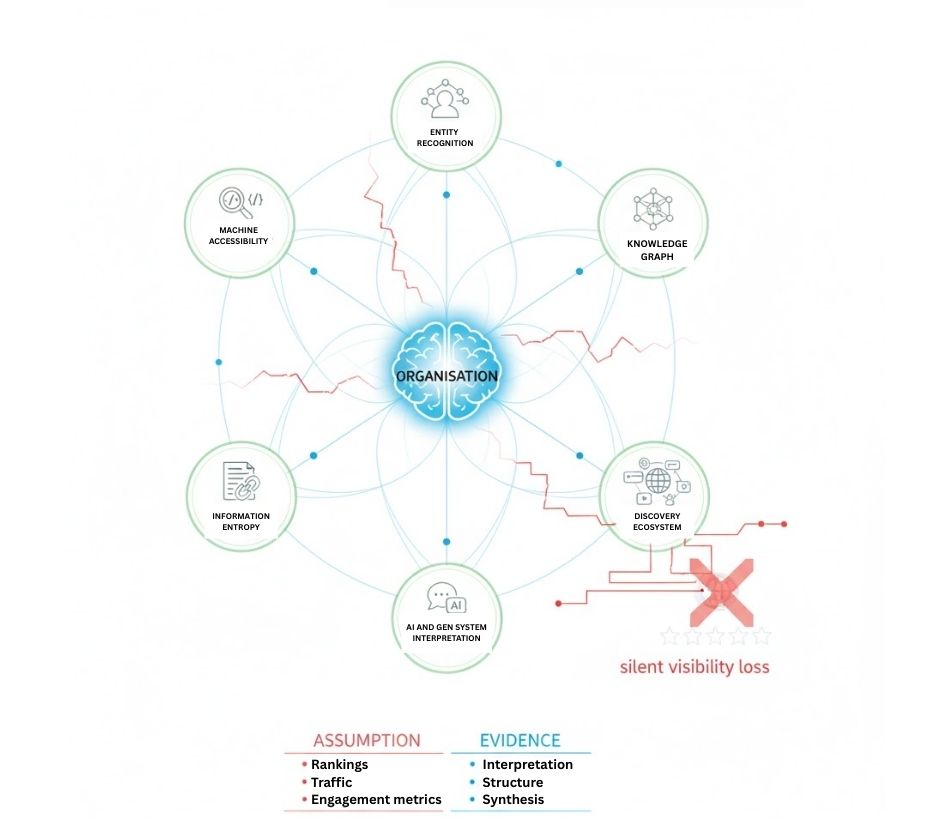
Machine Accessibility and Technical Integrity
Assessment of whether discovery systems can reliably access, parse, and interpret key information assets.
Entity Definition and Recognition
Evaluation of how the organisation is defined as an entity, including naming consistency, identifiers, and relationships within knowledge graphs.
Information Consistency and Entropy
Identification of conflicting, duplicated, or degraded information across the web, referred to as Information Entropy—that reduces machine confidence and prevents accurate attribution.
Knowledge Graph Presence and Relationships
Analysis of how the organisation is connected to people, places, concepts, and categories within structured data systems.
AI and Generative System Interpretation
Observation of how AI assistants and generative systems currently describe, summarise, and reference the organisation.
Wider Discovery Ecosystem Coverage
Review of presence across platforms that influence modern discovery, including search, social, video, forums, and data aggregators.
The output is not a checklist. It is a diagnostic map of how meaning is currently constructed around the organisation.
From Assumption to Evidence
Many organisations believe they understand their visibility because they can see rankings, traffic, or engagement metrics.
Discovery Diagnostics operates at a deeper layer.
It examines interpretation rather than performance, structure rather than tactics, and synthesis rather than surface-level signals.
This distinction is critical in AI-driven environments, where visibility loss often occurs silently through misinterpretation rather than ranking decline.
All diagnostic findings are reviewed against Search Sciences™ measurement frameworks under scientific oversight to ensure consistency and interpretive accuracy.
Chief Scientist’s Note on Interpretive Risk: “In AI-driven systems, a brand can remain ‘visible’ in search results while being simultaneously ‘misrepresented’ in generative summaries. Discovery Diagnostics is designed to detect this interpretive drift before it impacts reputation.”
Mohammed Younis, Chief Scientist
What Discovery Diagnostics Produces
- A mapped view of the organisation’s information footprint
- Identified structural weaknesses limiting attribution and trust
- Clear prioritisation of semantic and structural risks
- Defined opportunities for improved machine understanding
- A factual reference point for future measurement and monitoring
This evidence becomes the foundation for Semantic Engineering and ongoing Search Intelligence
Who Discovery Diagnostics Is For
This includes organisations that:
- Are affected by AI-generated summaries or recommendations
- Operate across multiple platforms or regulatory environments
- Rely on authority, trust, or public confidence
- Have experienced unexplained visibility or attribution issues
- Are preparing for significant growth, scrutiny, or change
The methodology scales with informational complexity, not organisation size.
Discovery as a Principle
Within Information Science, discovery is not optimisation. It is observation.
Discovery Diagnostics reflects this principle by establishing clarity before intervention. It ensures that any subsequent structuring or optimisation is grounded in reality rather than assumption.
Every application of Search Sciences™ begins here.
Request a Discovery Diagnostic Assessment
Discovery Diagnostics is the required entry point into the Search Sciences™ methodology. It creates alignment, accountability, and a shared factual understanding before any implementation work begins.